Showing posts with label crafting. Show all posts

Friday, March 30, 2018

2017 Jingle All the Way 5k Race Recap

There aren't many races that I insist on running every year.  The Jingle All the Way 5k is one of them.  This was the sixth year I ran it.  Here are the recaps for previous years:  2012, 2013, 2014, 2015 (2014 and 2015 are lumped together because of the evolution of my costume) and 2016.  The first couple years I ran the race it was an 8k, then in 2014 and 2015 it was strictly a 5k (that went right past the the Capitol building so you could see the Congressional Christmas Tree!)  In 2016 and 2017, it offered both a 5k (3.1 miles) and a 15k (9.3 miles.)  In 2016 I ran the 15k, so this year I decided to run the 5k.

If you've run either the Cherry Blossom 5k or 10 Miler, the 15k course will look pretty familiar.  (The 5ks are fairly different, where the Jingle goes around the Tidal Basin, and the Cherry Blossom goes up to the Kennedy Center and then heads back.)

The night before I went through my small box of Christmas themed clothing and picked out a sweatshirt, tights and my usual running skirt that I made for the 2015 race.  I also grabbed a some base layers along with a small stocking that has a clasp I sewed in to carry my usual pre-race picky bar and slipped it onto my spibelt.


Race day was a breeze because my Dad took advantage of early packet pickup, so he got our hats and bibs at the Pacers Running Store close to him.  So the only other issue (besides the potential government shutdown since the race starts and ends on Federal land) was getting to the race.  For years Metro opened early enough on weekends that a 9am (or even 8am) gun time was a non-issue.  Then once the transportation system started a major overhaul they opted to open later on the weekends to allow more time for maintenance.  ANYWAYS!  I ended up buying us a guaranteed parking space through Spot Hero (click here to get $7 off your first parking reservation of $8 or more!  Full disclosure:  I also get $7 when you use my referral code.)   It made race morning super easy because I reserved parking in a nearby garage so it was one less thing on my mind.  It was even an easy drive over, so I wasn't missing the Metro at all.


After a short walk, we arrived at the National Mall and made a quick trip to the portajohns (no lines!) and headed to the starting area.  (We arrived a little later than I usually like to, but it was just a 5k.  After running a marathon, running a 5k feels totally different.)  Before I knew it, I was queuing up my Christmas running playlist and we headed off around the Tidal Basin.

As expected with Pacers races, it was another great race that was pretty uneventful.  There was one water stop at about the halfway point.  The race organizers even put a course marshal right by one of the small bridges and had them warn runners that it was icy from the previous day's snow.

Once I crossed the finish line, I got in line for a space blanket, water, a super cute snowman medal, banana, granola bar and some peppermint donut holes from Sugar Shack.  (The donut holes were awesome--peppermint powdered sugar on a lovely yeasty donut.)


This shouldn't come as a huge surprise, but once again I would highly recommend doing this race again.  The course is great for out of towners or those new to the area since even when they change the venue, it's scenic with all the familiar monuments within walking distance.  Everyone from runners to volunteers are in a great mood and wearing fun outfits and it really is fun going all out.  I don't usually wear elaborate outfits for a race, but when I do, it's for the Jingle.  In fact, I'm already working on my costume for this year's race on December 9th.

Saturday, July 16, 2016

Tutorial: How to Keep Shorts from Riding Up!

For as long as I can remember I've hated wearing shorts.  Why? The chub rub. I cannot wear most shorts without them crawling up, so running in them is pretty much out of the question.  Then I started going to boot camp in a warehouse that doesn't have the ac cranked up and I signed up for a couple races for later this summer.  So now, shorts aren't just an option:  They're very necessary.

But how to fix the eternal struggle with the hem crawling up after that first step? Enter the almighty Google.  A few websites had suggestions, and I decided the easiest way to go was this...


Clear silicone caulk.  Yes, the same stuff you use to seal cracks in windows and around tubs and showers.  It's weatherproof, so it should hold up to washing and drying (I wash my clothes in cold water and dry on low if I don't hang it to dry, so no worries there!)  And once it dries it's slightly rubbery providing just enough grip to stay down in the hardest workouts.

Just a note of caution:  Silicone caulk is a skin irritant until it has cured (or dried) which takes approximately 24 hours.  It also gives off some fumes so I recommend doing this in a ventilated area, and since one of those fumes is ammonia I also recommend doing this away from pets.  (Also because while I was working on this tutorial my cat decided to take a flying leap into my photo tent.  So I had to take a break to chase a cat to make sure he didn't get any silicone on him.)

Here's what you'll need:
-Clear silicone caulking, preferably in a squeeze tube. (This is about $4 at any hardware store along with the regular caulk you have to use with the gun, and one tube will be good for multiple applications.)
-A pants hanger that can twist around and a place to hang them 
-A cardboard box you can cut up
-Scrap paper, cardboard or fabric
-Shorts or running skirt that creeps up
-(Optional) Old credit card, piece of cardstock or another scrap piece of cardboard

Time:
10-15 Minutes (Active)
24+ Hours (Passive)

First test out your technique on a piece of scrap paper, cardboard or fabric so you can get a feel for how the silicone flows out of the tube.  (I definitely recommend doing this if the tube has already been opened since the silicone in the tip will have likely dried a little bit.)  I chose a piece of scrap fabric for testing.


I decided to just do a simple flat, linear application rather than a zig zag pattern.  The key is to press down to make sure the silicone can adhere to the fabric well.

Now you need the pair of offending shorts (or even a running skirt with built in shorts.)


Love these shorts, but in one step the gray shorts have completely disappeared behind the purple mesh.  Take them and flip them inside out like so


Now to cut up your cardboard box (I recommend starting with the flaps.)  Fit the pieces of cardboard to each of the legs so they can keep the fabric smooth and stretch it just a little, but not so much that the cardboard bends.  (This will also help flatten the silicone when you smooth it out.)  Now get your hanger. Preferably one that looks like this so you can have full access around your garment.


Now attach the hanger to the waistband of the shorts, hang them up and start applying.  (I hung them on the outside edge of my photo tent.)  I applied the silicone just below the hem, but I put on way too much (you'll see later.)  That being said, I recommend applying the silicone in as thin of a layer as possible ON the inside hem, using an old credit card or a piece of cardboard or cardstock to flatten the silicone and putting your hand underneath the fabric for extra support during application. The silicone grips the fabric well and is surprisingly stretchy so you should not have to worry about it breaking. As you go along flatten the silicone out using your tool of choice.

Soon it should look something like this (only flatter.)

Super simple! It took me maybe 10-15 minutes in total to apply the silicone to both legs of my shorts.  Now just be patient and let it sit for at least 24 hours to fully cure.

Next came my wear testing.  I wore them to my boot camp class that usually has us doing all kinds of jumping, running, lunges and various other vigorous exercises.  I still had to pull the shorts down (and up--the waistband could probably benefit from silicone too!) but significantly less often than before.  I considered the boot camp test a success.  Then I did a run test.  Three miles and again, minimal creeping!  However when lounging in them before my shower and during boot camp doing jumping jacks in front of a mirror I noticed this...


The line of silicone was totally noticeable to the point where the light color of the shorts made my thighs look like puffy marshmallows.  (So this is why you should flatten the silicone as much as possible AND apply it directly to the hem of the shorts.  It should make the silicone less obvious.)

Next test: Washing and drying.  Like I mentioned before, I normally wash all my clothes on cold and dry on low or hang dry.  The tag recommended washing in cold water and drying on low, so I washed them according to the instructions since that's also how I normally wash my clothes.  Here's how they looked afterwards...


Totally fine! It looks just the same as when I first applied the silicone!!!

So there you have it!!  The game changer because now you can wear almost any shorts in the store!  I haven't tried these with loose shorts, just compressive ones but I don't see why this wouldn't work on them as well.  (Anybody want to try and report back?)

Wednesday, December 9, 2015

Bib Holder Tutorial

Here is part 2 of my race swag display tutorials!  This tutorial will show you how I made my bib holder.

Materials:

4- 1 inch square bend screw hooks
single hole punch
This template (not necessary, but if you're using the other parts of this tutorial it makes things easier!)
acrylic paint in your favorite color(s)
paint brushes (these aren't the ones I used, but would work well!)
Your favorite picture hanging product (you will need something to attach to the back.  You can use 1 sawtooth hanger, or 2 d-ring hangers and picture wire.)


First, you can paint the boards or jump right in with transferring the words onto the plaques.  I found transferring the words first went a lot faster since I didn't have to wait for the paint to be completely dry.

For both parts of the tutorial, I chose to transfer the letters first.

The bib plaque is similar to the medal plaque, but with an extra couple steps for putting in the hooks.

To install the hooks:

If you're using the same rectangular plaque I did with the lettering on the left you will want the smaller set of screw hooks to be .75'' from the top of the board, and one at 3.25'' from the left, and the second at the 10'' mark.  For the larger set, you want this to be 1.25'' from the top, with the third screw hook being at the 2.5'' mark, and the fourth at the 10.75'' mark.  
While measuring I used a pencil to make a mark.  I recommend erasing it as much as you can, but don't expect it to go away completely.  I was able to cover it up with the paint.
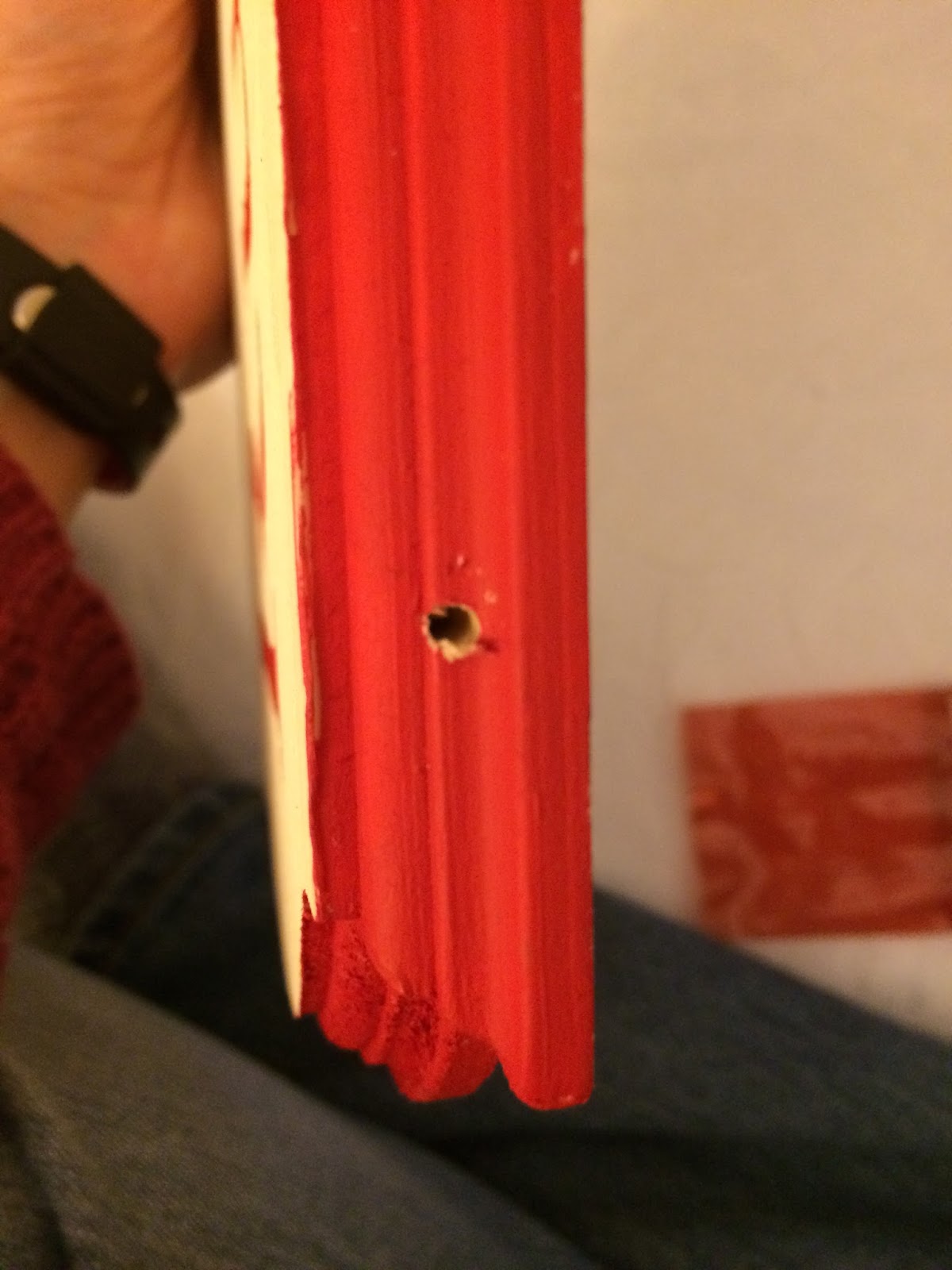
After checking my measurements pressed the screw hooks in to make an indentation for where I would install the screw hooks.  (The wood is soft enough that you shouldn't need any hardware to do this part.)  
Then once again I painted around the indentations.  Shortly after this I removed the bent screw hooks to make painting easier and to keep them clean.


I then checked to be sure my bibs fit.  This is where the hole puncher comes in handy, since not all bibs will fit perfectly.  Just use the hole puncher to make the holes slightly bigger or move them further out as needed.  Also note that for some bibs, you will need to remove larger timing chips.  To do this you can snip away at it using scissors.
I then transferred the smaller of the "Running" templates to the side of the plaque using a metal tipped pen similar to the medal holder tutorial.  
This is how it looked after painting the whole board.
I then filled in the border and the "Running" portions of the board and screwed the hooks back in.

And you're ALMOST done!
The next part is fairly easy, and it's attaching the hanging system for the plaque.  If you use the D-ring hanger and picture wire, you just have to screw the d-ring hangers on the left and right sides of the back of the plaque.  You don't have to worry about them being even because when you add the picture wire, it will help keep the plaque even when hanging.  You want to clip a little extra on each end of the wire to allow yourself some room to twist it around on itself like this...
Don't do like I did and allow yourself at least an inch on each side of the hangers so you have plenty to twist around on itself.
And now you're done!  Congrats :)  If you decide to try my tutorial let me know what you thought and I would love to see pictures of your work!  Also feel free to ask questions if I'm not clear about something. 

Tuesday, December 8, 2015

Medal Holder Tutorial

I know I kept saying that this tutorial is coming, but now that I've given one of the sets away as a birthday present to my Dad I can show what I did along with links to the specific products.  To break it up a little bit, here is the medal holder tutorial.  Tomorrow I will post the bib holder tutorial!


Here's what I used:
acrylic paint in your favorite color(s)
paint brushes (these aren't the ones I used, but would work well!)
This template
1 cafe curtain rod
2 #8 Screw Hooks  (Note:  If you buy these in store you can buy 1 package of two for about $1.18.  The link is for a package of 25!)
Your favorite picture hanging product (you will need something to attach to the back.  You can use 1 sawtooth hanger, or 2 d-ring hangers and picture wire.)

First, you can paint the boards or jump right in with transferring the words onto the plaques.  I found transferring the words first went a lot faster since I didn't have to wait for the paint to be completely dry.

For this one, I transferred the letters first then started painting.
The top of the page for this one lines up perfectly.  
I had it about half an inch from the top of the board.  


I then used a metal tipped pen to trace the template while pressing into the wood to make an indentation.


This is what you should have afterwards (if you don't paint first.)


If you chose to transfer the letters first, now you should paint the background color around the indentations.


Here's how it looks after outlining the indentations.


Then paint the rest of the background color to fill it in.


Then paint the second color in the lettering.


It's not perfect, but still looks great!


Painting the border.


Painting is done for the medal plaque!
After I was done painting, my husband offered to drill holes to make the screw hooks go in cleaner.
The holes are approximately one inch from each bottom edge.


Then screw in each of the hooks.  I was able to start them by hand, but then used pliers to get them in further without hurting my fingers.


Once the screws were in, I attached the cafe curtain rod and it's almost done!
The last step is installing the d-ring hangers and attaching the wire between the two hangers.  You just need to screw in the hangers on the left and right sides of the plaque and then use the wire to attach the two.  (Be sure to allow yourself at least 2 extra inches so you can twist the wire on itself.)  When you're done, the back should look something like this...

And now you're done!  To add your medals just slip the cafe curtain rod off the hooks and thread the strap of the medal onto the rod.  And since the cafe curtain rod is expandable you should have no problem using this plaque for a long time.

Friday, October 23, 2015

What to do with shirts? Bibs? Medals?

Racing is fun, but over time you accumulate a LOT of shirts, bibs and medals.  

Medals are fairly easy--you can buy a wood plaque at any craft store, paint it to your liking, and screw some of these hooks into the board.  This is what my display board looks like!  

My medal rack.
I think I need an upgrade already!
I painted the whole board with white acrylic paint, then the trim in purple.  Once the paint dried I chose to just put "Running" at the top.  I printed out the word in several large sizes to see how it would fit best on the board.  Then I used a pointed tip pen and outlined the letters by pressing into the paper and wood hard enough to leave an indentation in the wood.  Then, you simply paint inside the indentations!  (Yes, it does require a little bit of a steady hand.  But it's worth it!)  If you're short on time or uncomfortable painting, you can also use vinyl lettering or stencils found at any craft store.  I plan on making a tutorial for my transfer method soon with the gift giving holidays coming soon, the plaque makes a great gift for any runner! And I have a few runners in my life who could use one of these. (We can always use more options for displaying medals.)

If you aren't interested in having your medals hanging around, consider donating them to an organization like medals 4 mettle! (The medals are given to encourage people with handicaps or fighting serious diseases.)

Bibs are also easy.  I keep all of mine in a binder using page protectors and have written the finishing time and average pace on each one.  However for display purposes, I plan on making a plaque for them soon along with a new rack for my medals.  (Tutorial to follow later!)


You can also do something similar to what I did for my medals, but it can be tricky because bibs can come in a lot of sizes so the screw hook placement can be a little iffy.  There is also a company called Mile 22 that can make tote bags out of your old bibs!  A company called Spoonflower also has a tutorial on how to make your bibs into fabric.  (It requires scanning them, so you still have them intact but also have a great medium to work with too!)  Just be aware that it can be time intensive and get a little pricey since it's custom made fabric.

Shirts are a little more difficult to work with, because of the different fabrics.  A stack of cotton tee shirts (not technical tees) can easily be made into a quilt.  A produce bag or a tote bag!  Just be aware that technical tees though are a little more difficult to work with, because of the slickness of the fabric itself.  But you can use little tricks like putting a sheet of paper on top and bottom of the fabric while you're sewing.  This helps the feet of your sewing machine get just enough traction to be able to feed the fabric through.  When you're done you can just pull the paper off the fabric (or cut very carefully along the seams) and you're done!


How do you display your race swag?